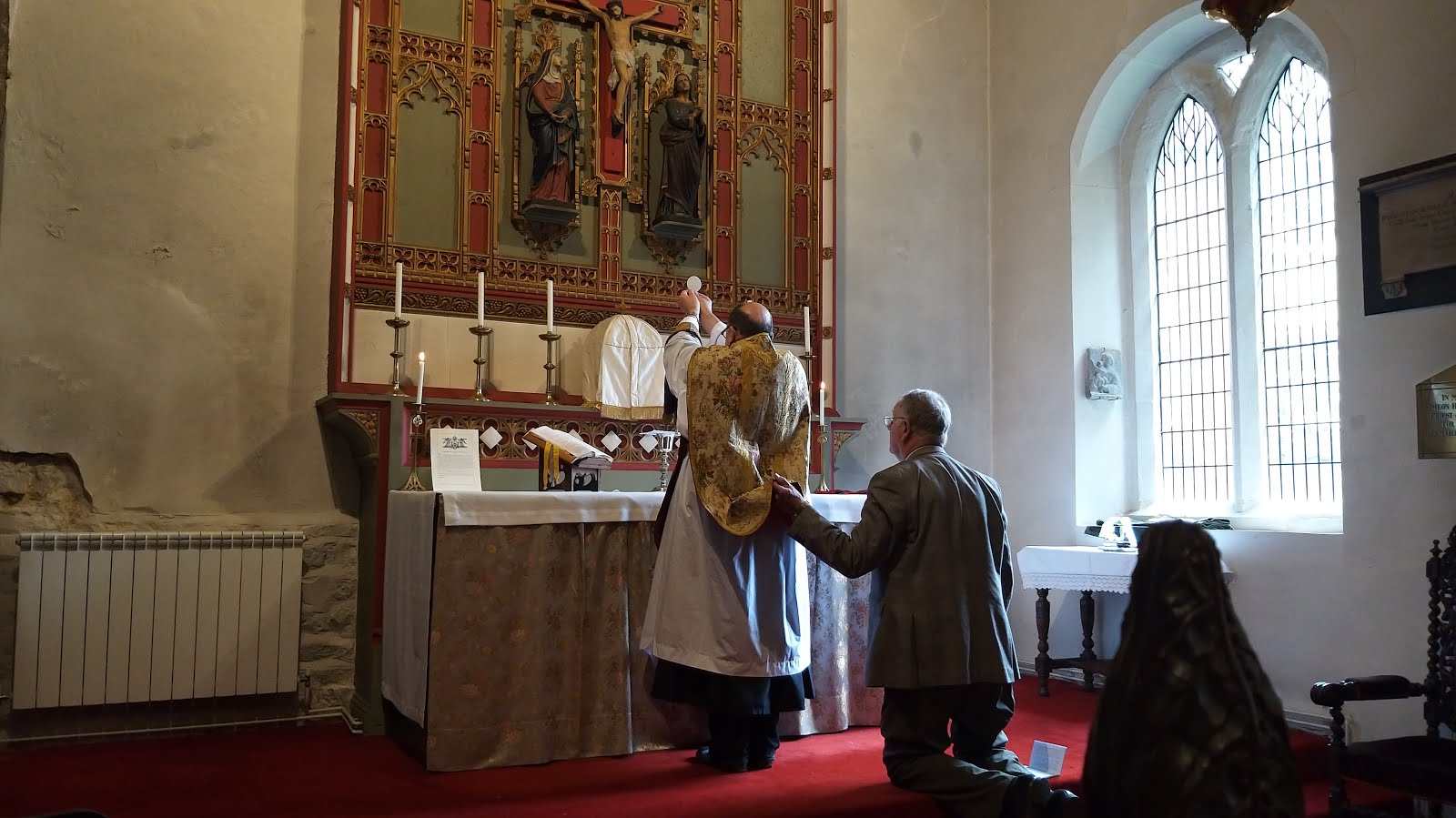
The purpose of this blog is to provide an open forum for discussion of the aims of the society; news from the wider Church and details of Masses and events of interest in the diocese. The Latin Mass Society in the Roman Catholic Diocese of Middlesbrough expresses its full filial devotion and loyalty to Holy Mother Church, Pope Benedict XVI and Bishop Drainey.

24 May 2013

Corpus Christi

This is a reminder that Thursday 30th May is the Feast of Corpus Christi, and until 2006 this was a Holiday of Obligation.  In that year, the Bishops' Conference of England and Wales decided to transfer the feast to the following Sunday, a practice that had already been established many European countries.  In my view, this is a great pity, and has resulted in this very important feast being downgraded in the eyes of most people to be the same status as an ordinary Sunday.

With the very few priests that we have in the Middlesbrough Diocese able to celebrate Mass in the forma extraordinaria, it is difficult for us to make any special arrangements for the keeping of this feast on its traditional date.  However, there is an opportunity to celebrate Corpus Christi, albeit on the following Sunday, in a rather special way at New Brighton on the Wirrel.  Here are the details:


Sunday 2nd June

11.30     Sung Mass
12.45     Outdoor Procession
13.30     Benediction  (using the great monstrance)

Followed by social event   -   bring food to share


The great monstrance has to be seen to be believed.  It is six feet tall, and is winched into its position in a throne above the altar.

16 May 2013

Sunday 19th May

As this Sunday is the third Sunday of the month, there will be Benediction after the 4pm Mass at English Martyrs' Church in York.

09 May 2013

Missa Cantata in Darlington

There will a Missa Cantata in Darlington on 15th May.  The details are:

               Place            St Augustine's Church

              Time             7pm

              Date             Wed  15th May

              Setting          Byrd   Mass for Four Voices

Try to get there if yiou can

08 May 2013

Holydays

The coming of Ascension Day, tomorrow, reminds me that we are still waiting for the Conference of Catholic Bishops of England and Wales to make a statement transferred Holydays.  One might have expected them to have something to say following their recent meeting in Rome.

The bishops were taken a little bit by surprise when there was widespread opposition to Holydays being transferred.  It was widely rumoured that there was agreement that the matter should be reviewed, but the years pass by with no public statement.  Maybe the bishops need a gentle reminder.

Statistics

I have had another look at where our readers are located.  In the last week, the top six countries are:

            UK            143
            USA            57
            China          23
            India           16
            Ukraine      12
            Russia         10

The York pilgrimage probably accounts for a spike in UK figures, and USA is generally at or near the top.  However, the showing of China, India, Ukraine and Russia would seem to suggest continuing interest in traditional Catholicism in Asiatic and former communist countries.  All good news for the Church.

More on St Margaret Clitherow


Here is the procession passing through The Shambles , where St Margaret Clitherow lived.

Margaret Clitherow honoured in York

The procession setting out from St Wilfrid's Church


You will see that the statue of St Margaret Clitherow was carried along with a couple of banners, one for the Latin Mass Society and th other for St Margaret Clitherow.  The procession continues off the edge of the picture.

Here is the elevation at the Mass celebrated by Canon Montjean.


27 April 2013

Priest Statistics

Some readers may have been following on other blogs a debate about how the number of ordinations in the last few years compares with earlier times.  It started with the National Office for Vocations publishing some obviously erroneous figures, from which it was asserted that the current numbers are vastly higher than the numbers for the 1930s and 1940s.

After some delving, I found a table of statistics on a website called ukpriest.  This is an official website of the National Vocations Office, so should be reasonably reliable.  Amongst other figures, it gives the number of priests in England and Wales for each decade from 1841 to 2001, with the exception of the year 1891 which is missing.   One presumes that it includes religious as well as secular clergy.  Here is the relevent extract:

Year                    Priests                     Change

1841                      561     
1851                      826                         +265
1861                    1165                         +339
1871                    1551                         +386
1881                    2498                         +947
1891
1901                    2856                         +358
1911                    3766                         +910
1921                    3989                         +223
1931                    4484                         +495
1941                    5838                       +1354
1951                    6729                         +890
1961                    7465                         +737
1971                    7618                         +153
1981                    7016                         - 602
1991                    6261                         -755
2001                    5600                         -661

These are numbers of priests, so to get to ordinations, we would need to know the number of priests who die or leave the priesthood each decade.  I do not have this information.  However, the trend is very obvious.  The number of priests increases each decade until 1971after which it decreaseseach decade.

Analysis can only be as good as the raw data, and I have some suspicions about some of the figures.  Can anyone explain th big increases indicated in 1881, 1911 and 1941?

16 April 2013

Do we really have a Shortage of Priests

One thing that struck me last week when I was at the priest and server training conference in Leicester was the number of prospective priests amongst the servers.  Included in the twenty or so laymen who had enrolled for the purpose of learning to serve, or of improving their serving skills, there were at least four who were intinding to pursue their vocation to the priesthood.  Most of these had made alpplications to their bishops or diocesan directors of vocations, and been advised to go away for a period and gain a little experience of the world before resubmitting an application.

Thinking back over earlier training conferences, I recall that in each of the last four years there have been a significant numberof young men who were quite open about their intention to pursue a priestly vocation.  Some are now in seminaries, including those of the traditional societies, and others are still waiting to be accepted.

Meeting so many of these prospective priests, one cannot help but feel that in future decades, those parishes lucky enough to have a resident priest will be in good hands.  This view tends to be reinforced whenever one meets current seminarians or indeed newly ordained priests.  The quality seems pretty good.

The downside is that, however one looks at the statistics, the number of active priests in England and Wales is likely to continue to decline for another twenty years.  The next ten years is fairly predictable as most of the priests that will be ordained in this period are already in seminary or in a process of discerning their vocation.  For the situation to improve after that, there would have to be fairly major upturn in the number of vocations.  There are some signs that this is already happening in a minor way.

A factor that is rarely taken into consideration when predicting the numbers of future priests is the selection process.  Of course we will never know what criteria bishops use when deciding whether to select or reject a particular candidate.  However, my impression is that many of the young men that I have seen taking part in LMS training conferences would not have passed the selection process a decade ago.  They would have been considered over pious, too traditional, or possibly branded as insufficiently mature.  Fortunately these views are changing.

So this leads me to wonder: Could it be that the shortage of priests need not have happened?  Is it, at least in part, due to the rejection of many candidates who would have made excellent priests?

LMS Chairman: More from the Ratcliffe Conference

LMS Chairman: More from the Ratcliffe Conference